Showing posts with label red umbrella. Show all posts

Tuesday, April 20, 2010

A Bigger View of a Smaller Garden, Part 1

You might have noticed that my blog photos tend to focus on garden details, without giving much context. I recently read a Bloom Day post that combined detail shots with broader views, and was inspired to reveal a bigger picture, starting with my back garden.

Built three years ago from the bare dirt up, it is just starting to come into its own. Being a designer makes a project like this both rewarding and excruciating; the position of every element can be endlessly agonized over in your own garden. I know a design is a success when any key element would be immediately missed if removed. It works because it works together, and I can't stress enough how important the simple act of placement is, in any kind of design.

The fountain sits in the open area between the bamboo grove and the patio, and can be seen from almost anywhere in the garden; this view is from under the Red Umbrella. The Giant Clumping Timber Bamboo (Bambusa oldhamii) sends out a few new culms each year; I choose which ones stay and thin out older ones as needed. I want a screen, not a wall!

A low-maintenance garden like this isn't a no maintenance garden; I usually have two or three good "editing" sessions a year, when things are moved, removed, thinned or pruned. I'll trade that for weekly mowing, edging and blowing any time.

From the patio you can also see the Kuan Yin statue and the path to the Red Umbrella. This whole corner is about 15' square. Cobble from under my street trees runs throughout the garden; here it rings the sitting area and the fountain.

The plants are mostly compact evergreen shrubs; Nandina 'Firepower' Variegated Boxwood, Coprosma 'Evening Glow,' and Ilex x 'Mondo,' mixed with Berkeley Sedge (Carex divulsa) and Heuchera 'Plum Pudding.' The unifying ground cover is White Start Creeper (Pratia pedunculata).

I save the riot of color for my sunny front garden; the plantings around the patio are peacefully simple and designed to be a fun place for my cats to play; the large tussocks of Berkeley Sedge are accented by variegated boxwood and three taller clumps of Korean Feather Grass (Calamagrostis brachytricha) whose puffy late-summer blooms explain my name for it: Cat-Toy Grass.

Pulling back farther you can see how the combination of three Carolina Cherry Laurel (Prunus caroliniana 'Compacta') standards and two Purple Hopseed (Dodonea viscosa purpurea) shrubs follow the curve of the patio, screening the view of my neighbor's roof.

This is it, my back is against the fence! Raised beds make a Kitchen Garden in this sunny corner; the section that wraps around the windmill is planted with thyme, sage, marjoram and chives.

The south-facing bed is a great spot for a six-variety apple espalier: the fence behind it makes it so easy for the squirrels to reach every one! The poppies and alyssum will get pulled out soon to make room for peppers and basil.
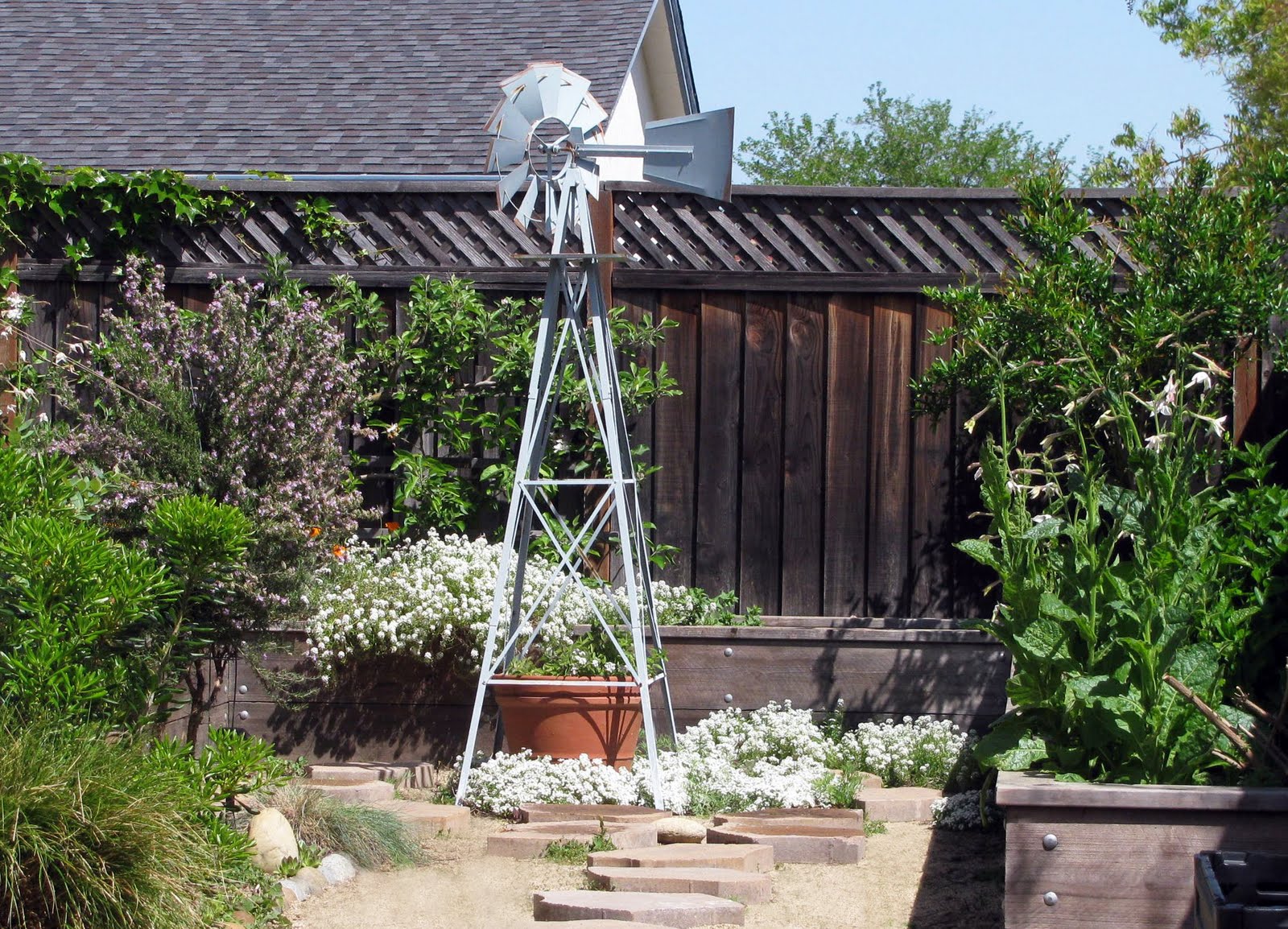
The raised beds were a great way to utilize this corner. The section along the right fence is ~24' long. Other permanent Kitchen Garden residents are rosemary (which seems to be turning into a small tree) a pomegranate in the back corner, pineapple sage in the pot under the windmill and lemon verbena. One day those stepping stones will magically sink into the decomposed granite.

We're way overdo for a pretty close-up! This succulent took on some beautiful tints over winter.

The view from the courtyard; you can see how the Prunus and the Dodonea work together to make a very effective screen with plenty of room underneath to plant. After 3 years I was finally able to skirt the Dodonea up and reveal their developing trunk structure (they were about 3' tall at planting).

A big stack of these simple Holland pavers were already on site, left over from a previous patio. I added half a pallet of mixed colors to liven it up, and had them laid in my favorite diagonal herringbone pattern.

*New* Realized I was missing the view into the courtyard! When I moved in the house had just been remodeled; these two wings had been added, and it was just bare dirt and my poor kitchen window! I was renting at the time, and my landlords graciously allowed me to design the steps, patio and arbor to finish it off. It has become a wonderful transition space from my office and bedroom into the garden.

So that's pretty much the whole garden from end to end: you can see the Kitchen Garden from under the Red Umbrella. I don't spend much time here in the winter; being on the north side of the house it can be cold and damp. But from spring to late fall it's where we live; and every inch is used.

A few more details, like Kuan Yin's serene profile. She's seen me through a lot. Every garden needs a goddess.

Heuchera 'Plum Pudding' is one of my favorites; especially this time of year. It's better for the glowing foliage than the unremarkable flowers,

Carex morrowii 'Ice Dance' is not grown for its bloom, but with the right lighting everyone can be a star!

That same backlighting sets the Azara dentata aglow. Thanks for joining me for a bigger view of my small corner!

Wednesday, October 7, 2009

Changes Under The Red Umbrella

For as long as I've lived here, the house next door has been empty.
(See 'My Neighbor's Manihot') At first it was an empty OLD house, with a wild, overgrown garden that poured over the fence. Then it became an empty NEW house; remodeled and expanded from top to bottom, just in time for the housing slump. During the remodel the garden was cleared, a rather shocking change.

But look how some of my neighbor's plants returned to help. Slender Manihots, from seeds her trees flung into my garden. Vigorous (but firmly contained) running Bamboo along the walk, and a sturdy Fig tree (that actually crawled under the fence) sheltering the Red Umbrella corner. I like that her garden continues in mine, and hope someone thinks as generously about MY bamboo one day!


But other changes are afoot under the Red Umbrella. Everything looks normal, right? Look closer and you can see a whole lot of daylight coming through that fence, because the large shed on the other side was removed by the (drumroll) New Neighbors (who moved in while I was out of town recently-surprise!)


3/4" spaces between the boards, and some very large knotholes are making my formerly uber-private little nook feel a little exposed. I mean, I can see their STUFF over there!

Gaining visual privacy won't be difficult. The Boston Ivy is on its way, and I've got some fun ideas for the fence. What I wonder is, how will they be using THEIR corner? Will it be a patio, a vegetable garden, a hot tub? A children's play area? A meditation garden?


It will be interesting to see what happens. I've been fortunate to have such a quiet, private spot for years; now it's time for things to be different. With every change comes opportunity.

Maybe I can interest them in a nice shrubbery!

Sunday, September 13, 2009

I Used To Have a Lawn, Now I Have a Sanctuary

I am honored to write the first post for Lawn Reform's 'I used to have
a lawn' blog contest. I'm glad to share my blissfully lawn-free garden existence, and hope you will too!
When I was designing my back yard, someone suggested I put a lawn here. Insisted, in fact. Since he was my landlord and paying for it, I didn't have much choice. So I simply stalled the project until the house was mine, then did exactly as I pleased.

No doubt you are getting thoroughly tired of the Red Umbrella, but we'll start there to orient you for the rest of the tour.

The view from under the Red Umbrella. I have spent a lot of time contemplating my fountain this summer. It uses MUCH less water
than the equivalent in sprinkler gazing.

At the center of things is a simple paver patio. There used to be lawn here too, before my time. I would much rather go sit out in the middle of the yard on a starry, starry night without getting my socks wet, wouldn't you?

Around the patio are sturdy evergreen shrubs accented by grasses.
My cats find this kind of garden MUCH more entertaining than turf (which gets their feet wet too!)

In the sunny corner of the garden I have vegetable boxes where I grow herbs, apples, tomatoes, pomegranates, peppers and wildflowers in a rather casual way. I guess I could make some nice compost from a lawn...but I simply want more.

There are lots of dry little corners, perfect for succulents. This is the kind of edging I like.

Just because it's a paved, doesn't mean it isn't a garden. Buddha
sits on the step next to my office door. The succulents do get watered...occasionally.

Shade-loving plants in glazed pots cluster in a sheltered corner of the patio. They enjoy regular water, but almost never need mowing.

Outdoor space can be used in so many ways, it seems a shame to dedicate so much of it to lawn out of...habit. Especially in a dry summer climate like California. But things are changing, and my clients are losing their lawns by the yard...and gaining so much more.

I toast this trend with satisfaction (and dry feet) from my sanctuary under the Red Umbrella.

Congratulations on your launch, Lawn Reform, long may you wave!

~~~
To participate in the Lawn Reform Blog Contest, simply write a post on your blog that completes the statement: “I used to have a lawn, but now I have…”
  • You can answer in words, pictures or both.
  • Links to previous posts are welcome.
  • If you but dream of a future with less lawn, feel free to complete “I still have a lawn, but one day I’ll have a…”
  • Once you have posted, go visit Susan Morrison at Blue Planet Gardening and sign it up using the Mr. Linky widget.
  • On September 30, Susan will post the randomly drawn winners and share highlights.
  • Don’t forget to visit the Lawn Reform website and download a badge for your blog!

Saturday, August 8, 2009

My Bamboo Is Scaring Me!

As you may recall from my earlier post, I have a favorite sitting corner in my garden (The Red Umbrella!) that is surrounded by four robust specimens of Bambusa oldhamii; giant clumping timber bamboo. This species was suggested to me by a trusted plantsman, who then found them for me and presented them as a gift for my new garden. So I was meant to have them! And they are fabulous.

This is how my corner looked two years ago, about three months after planting. The bamboo had just been through its first 'shoot' which is the period in July/August when the new growth starts. The culms are noticeably thicker each year, and reach full height by winter, staying tightly sheathed all the way up (tallest are well over twenty feet now). In spring they let loose leafy side branches. Here you can see the utility pole in the corner; but you never will again!

That same new growth from two years ago has turned golden, and is considered mature. Last year's culms are still green. And this year? Um, can you see why my bamboo is scaring me?

My task as a responsible, rule-breaking gardener is to keep these beasts in check. Which is surprisingly easy to do, if you deal with them before they are bigger than you are! I have three ways of helping my bamboo do my bidding.

The first approach is a short, sharp, shock. You can see this unfortunate fellow at the far right in the picture above. Too close to the path, no shoot for you!

Until it is about two feet tall, a bamboo shoot is very pliable and loosely connected at the joints, just give it a wiggle and it pops right out. To further control growth from this spot I could dig it out more, but it won't be up to any more mischief this year.

This species of bamboo is also edible; if I were more adventurous in the kitchen I'd think of something tasty to make with it. For now, it's nicely compacted green waste. [see comment from Annie below for a preparation suggestion, courtesy of none other than Allen Lacy, one of my pantheon!]

The second way I work with bamboo is by training the new culms, which are often pointing in odd directions (continuing the trajectory of the rhizome below the ground, I guess). Such waywardness can be turned to an advantage with the right training, giving the culms graceful curves.

When they have reached about four feet and their bases are hardened
a bit, I train new culms by tying them to older ones (built in plant stakes!) By doing this I can separate canes that are growing too closely together, position the tall plumes just where I want them, and encourage the elegant interplay of the culms at ground level. I like to use raffia-wrapped wire, as it is inobtrusive, strong, and reusable.

Old-Hammy would love to be leafy to the ground, but for my small space I want to keep the lower part of the culms clean. So the third trick to bamboo dominance is removing the leaf nodes at the joints. Again, if done cleanly and early, they won't sprout again.

One of my design inspiration books is about Japanese courtyard gardens. My favorites feature timber bamboo, trained by skilled masters to just a few choice culms, in some impeccable setting.

So I am NOT insane!

The tallest culms now meet over the top of the Red Umbrella. Between the dappled shade and the way it catches every breeze, my scary bamboo has made this a heavenly place.

Understanding that I am the master here, and making the sometimes ruthless choices needed to develop the space, has been critical. I think of it as editing the garden; removing what is superfluous and grooming what remains so that it can shine.

Tuesday, June 23, 2009

In The Garden with Alice

Last week I visited garden travel writer Alice Joyce (Bay Area Tendrils), and spent a delightful few hours in her charming garden, located just 20 minutes north of San Francisco. I knew I was meeting a kindred spirit as soon as I saw her Red Umbrella! We drank iced lemon verbena tea, and she shared the story of her garden, including the provenance of her impressive collection of plants. Alice's garden is a rich tableau (built one compact-car load of materials at a time) which will continue to evolve as the plants mature under her guidance.
Alice is an artist first, and this shows everywhere in her garden; from the clever use of applied color and found objects to the artful combination of foliage textures. It made me think about how different a hand-built garden is from a landscape that is designed and built all at once. Alice's sketchbook (above) filled with notes, lists, clippings, sketches and ideas, collected over the life of her garden, is quite different from the neat CAD plans and Excel plant lists that describe the design projects I do.
Few of my clients are serious gardeners; you will not find them pointing out the stunning combination of purple Corylus leaves and the vining tendrils of variegated Ampelopsis, as Alice does here. The gardens I design are valued and appreciated for their combined beauty and durability, and not so much for the special attributes and personalities of the plants I use.
So it is always a treat for me to visit a hand-built garden. I can appreciate the gorgeous plant combinations: some of them intentional, some happy accidents.

Here the fine purple leaves of Sambucus nigra 'Black Lace' are the perfect foil for the coarser green leaves of Lemon Verbena (the source of our tea, and easily the best lemon scented plant I know, including lemons!) Each of these plants needs some training to remain in bounds and attractive, especially in a small garden. Therefore, I might hesitate to use them front and center in a 'designed' garden, unless a skilled gardener is also on hand to guide them through the seasons.

One of the most challenging tasks for me as a landscape designer is choosing all the plants for a garden at once. This certainly is not the nature of a gardener, who acquires plants from a variety of sources over the years, tucking them in as they are acquired, and perhaps moving them about as they mature and their habits are discovered. Garden writers like Alice also regularly receive trial plants from growers, so many of her favorites came to her by chance. For me, that is a great way to build a garden, around a collection of plants.
Consider the beautiful combination Alice has created above...a bed of Gold Heart Ivy, through which Begonias and Lysimachia 'Outback Sunset' emerge and blend. This has taken years to achieve; my attempts to recreate would no doubt look pretty small for quite some time. The imperative to create landscapes that are lovely in infancy as well as in maturity might lead me to safer choices. But my personal preference is for these thoughtful, elegant constructions any day!

I particularly love how Alice used two accent colors, a rich Moroccan blue and a creamy yellow, consistently throughout the garden. Here sections of trellis emerge from the gold like gems, and the combination glows all year round.

Another lovely detail. Look at this beautiful piece, tucked into a shady corner. A simple wrought iron plant stand, topped with a lacy openwork sphere, both painted that rich yellow. So simple, so effective, the work of an artist. Such details cannot be contrived for a client out of thin air, unless they have the makings of them already.

An avid gardener, living in their garden day to day, year to year, knows the little touches that make their space unique. Knows the splashes of color that need to be added. My best hope is to inspire my clients to such details over time. To add these personal touches for them feels rather like presuming to name their children!

The other thing I pay attention to when choosing plants for client projects is their susceptibility to disease. Melianthus, for instance, which Alice is showing below is notorious in these parts for attracting whitefly. I might hesitate to invite an infestation into a client's yard, particularly if I'm encouraging them not to spray. But I'm willing to accept responsibility for whatever I plant for myself, and know that there will be wins and losses.
The other huge difference between a hand-built vs. a contractor built garden is, of course, the hardscape. How would I specify this gorgeous outcrop planter Alice created out of field stones and cobbles? Such a delicious little confection can only be created on the spot, really.
Containers are the other 'old friends' in a hand-built garden. I use containers all the time in my designs, and they are usually purchased all at once and coordinate beautifully. But my own courtyard is a wonderful hodge-podge of pottery purchased over the last 10 years or so, and therefore, like Alice's beautiful grouping below, much more interesting. It's nice when a client has a bit of a collection to start with. And containers don't have to have plants in them to work...One shallow vessel in Alice's garden below is filled with green glass; another year-round easy pop of color.
When I design for non-gardeners, I have to assume that the plants I choose will only receive minimal attention. They need to get along by themselves, and play nicely with their neighbors. For this reason, I pay particular attention and obey the rules regarding plant size and spacing.

But in my own garden, those rules are flexible, and I regularly bend nature to make my plants do as I wish. I think this is true for many gardeners. Alice described training her Cotinus to have the upright, graceful posture of a dancer. A gardener can decide exactly what effect they wish to create, and will deliberately choose plants that need guidance over the years to achieve their objective.
When I see a beautiful combination like this (Crocosmia, Cuphea and Teuchrium) my gardener's soul is satisfied. I realize how I have come full circle, from gardener to designer back to gardener again. Perhaps the two need not be so different after all, and that the true mark of my success as a designer will be in their synthesis.

Sunday, June 14, 2009

Under the Red Umbrella

One of my favorite places in the garden did not have a promising start. It was a dry, lifeless corner, dominated by a large telephone pole, an aging wood fence, and the looming jungle of the abandoned garden next door. Maybe 15 feet square, it could simply have been a nice focal point from the patio, a colorful bit of garden to walk through to get to the side yard. It certainly wasn't going to be a lawn! Since I'm someone who would rather be in a garden than work in it, this seemed a natural spot for a peaceful meditation circle.

So that's what I made. A simple, 10' wide circle, ringed with my ubiquitous river cobble and filled with gold fines. In the center, 4 concrete pavers form a compass rose. A plastic sleeve sunk in the center holds an umbrella in the summer. In the winter, this northwest corner catches the sun. Simple concrete stepping stones connect the circle to the main patio. Look closely...what appears to be an opening in the fence is actually a mirror...it fools everyone at least once.

An overflowing pot water feature (look familiar?) and a statue of Kwan Yin are positioned as focal points from both the meditation circle and the main patio

The groundcover is Isotoma fluviatilis (or laurentia or pratia or whatever it is this week...I learned it as Isotoma, so there.) Both this and the side path were planted with one flat 2 years ago, just a couple of small clumps between each stone. It stays quite flat in the sun, a little flufflier in the shade. Peak bloom is in May, with a scattering of flowers until late fall.

The bamboo is Bambusa oldhamii...giant CLUMPING timber bamboo. These were planted 2 years ago from 15g cans...all of this is new growth since then. Each clump puts out a number of new canes each summer...I choose the ones I want to keep (they are easy to "wiggle" out when they are under a foot tall) and cut older, thinner canes as new ones come in. This wants to be a dense clump, but I prefer to keep them open, so the discipline will continue! The tallest ones are already half as tall as the telephone pole. Right! What telephone pole?

Last year I had a plain beige umbrella in this corner. It looked very sleek, but this year I was inspired to add some color when I spotted this beauty on sale for an incredible price at my local overstock store. I had wanted a plain wood pole too. Of course, the reason it was so cheap was that it had a defect...the pole had a curve in it. Which, for me, was the perfect solution to the one problem I had with my clever umbrella holder. Since the umbrella is not in a stand, it sits lower than it would on the patio. When it's absolutely level, the corners are dangerous to anyone over 6' tall. Since my sweetheart is 6'3", and I value his eyesight, having the umbrella curve was perfect. It also gives it a more casual look AND blocks the west sun better. I love a happy accident!
But the best part isn't how pretty this little corner now looks and smells, it's how wonderful it feels. This isn't a garden I dig around in all year round...spring and fall cleanup, a little weeding, plus a mid-season haircut for the Berkeley Sedge is all I really have to do. And that's good, because what I really like to do is sit under the Red Umbrella, and I do so several times a day, for most of the year. It is a place to relax and dream as I look down the whole length of my little piece of California.

When I have visitors, we go sit there. One night my sister, our friend Ruthie and I sat out there with our laptops (the Red Umbrella has WiFi, of course!) for all the world like the 21st century version of the quilting bee...pooled feminine energy, sharing time together, swapping stories (only sometimes the stories are on youtube...same thing!)

Under the Red Umbrella is where you will get my most sympathetic ear, my most honest advice, and my most creative thoughts. My neighbor slips over to share a forbidden cigarette and escape work stress and small children for just a few moments. She looks around and can't believe it's the same place it was before. And you know? It isn't.