Another reason to appreciate my new place: it's a short walk to this spot, one of the Campbell entrances to the Los Gatos Creek Trail, which follows (surprise!) Los Gatos Creek from Lexington Reservoir to San Jose. Wide paths along both banks in this section make a great 2-mile loop for just about anyone on feet, paws or wheels. ~click any photo to enlarge~
Today it really felt like spring on the trail, after a rainy and chilly week. Loved the remains of these wild almond blossoms...the petals were white, these are just the stamens!
Still my favorite red berries, Toyon (Heteromeles arbutifolia) has been looking great since December.
More almond blossoms...
Doesn't this just shriek spring?
Huge native Sycamores (Platanus racemosa) on the banks are just starting to put out their leaves, which will be the size of dinner plates by summer.
Thick stands of Fennel (Foenicululm vulgare) are sprouting amongst last year's stalks, and will soon be waving their licorice-scented fronds high overhead.
More Sycamore leaves...
Sycamore leaves and fruit...
Willow catkins!
A lone cattail, about to implode...
Fresh new leaves on the Willows...
I love this stage of Redbud (Cercis occidentalis) bloom, when the tiny heart-shaped leaves start to emerge as well...
Some of the bushes (perhaps the really happy ones?) have flowers along every twig.
Vigorous tufts of pleated leaves launch this year's Buckeyes (Aesculus californica).
The new growth on the live oaks looks like flowers. See how these things can grow several feet in a season?
Lots of water in the creek, and our loop is complete! I think this will serve as a good surrogate garden for me. (Next month...poppies!)
Showing posts with label California natives. Show all posts
Tuesday, March 1, 2011
Sunday, July 11, 2010
From Anagallis to Zaluzianskya at Annie's Annuals
Boy did I see some beautiful things at the annual 'Art in the Garden' party at Annie's Annuals & Perennials in Richmond, CA this weekend. Sunny skies, temps in the 70s after a foggy morning, and a light breeze made for a delightful couple of hours. Any of their weekend parties is a fun outing; if you live in the Bay Area a visit is definitely worth the drive. Go with a group so you can 'ooh' and 'ahh' together. Call ahead to see when Annie Hayes herself is there; a romp through the gardens and nursery with this flower child is not to be missed.
Many of their flowers are rarities I had never seen before, and yet could take home in a frugal little 4" pot if I liked. So feast your eyes; a full description of every one of these plants can be found on Annie's excellent website. I particularly appreciate their 'Totally Useful Plant Lists' because, let's face it, they have a shitload of plants, and you've got to narrow things down somehow! Here's what caught my eye yesterday...
This charming, long-blooming ball of blue is Blue Pimpernel (Anagallis monellii) a tender perennial in Zones 9-11. I would love to use this in containers, true blue is hard to find!
In fact, it would look lovely with Ruffled Snapdragon, (Antirrhinum 'Double Azalea Apricot') what a looker!
It's July and warmer colors seem to dominate, like this Calceolaria integrifolia 'Kentish Hero.' A favorite of the staff at Annie's because it has not been "bred into weak, boinky oblivion!"
But the sweet pastels of spring can still be found, perhaps with a bit more attitude, like this Corydalis sempervirens.
LOVED Crassula erosula 'Campfire' what a perfect name!
Cuphea 'Strybing Sunset' is a surprisingly low-key little plant, given the hot colors of the flowers; their small scale and the freshness of the foliage give it lightness.
I like how you'll never find two blooms exactly alike on the statuesque Dahlia coccinea; each has their own personality.
Uruguayan Firecracker Plant (Dicliptera suberecta) lives up to its, um, perky name! This one likes heat and humidity and is hardy to Zone 7.
I loved this perennial foxglove from Spain (who just won the World Cup! Well done!) Digitalis obscura is hardy to Zone 4; loves sun, sips water! And is now on my wish-list.
Ahh, I'm so glad I added this lovely native to my garden this year, Erigeron glaucus 'Wayne Roderick' named for a legendary California plantsman who died in 2003.
Here's another native for my list. Red Buckwheat (Eriogonum grande rubescens) likes dry clay soil and not much summer water once established. AND it has a long bloom period, summer to fall. Want.
Given that my Ghost Fuchsia (Fuchsia magellanica 'Sharpitor') is less than a foot tall, I was pleased to find this strapping six-foot specimen living happily in full sun. It looks so delicate!
A perky red perennial for dry shade? Yes please! Island Bush Snapdragon (Galvezia speciosa) is another lovely native from the Channel Islands that likes poor soil and little water.
There's a large specimen of Coastal Gum Plant (Grindelia arenicola) near the front gate at Annie's; little native bees practically bathe in the pollen (as you can see!) With a May-October bloom period this native would be a great addition to a habitat garden.
Another kicky red native hummingbird magnet for dry shade? Heartleaf Penstemon (Keckiella cordifolia) is going on my list too.
Whew, thank goodness we've reached the letter 'L' so we can cool down with a shot of Lobelia valida, a Zone 5 Hardy perennial that likes good drainage; it would be perfect in a container.
Marigold 'Harlequin' is an antique from 1870 enjoying a revival; makes a big rounded bush with these great stripey flowers!
Another cool breath of blue, this time from Monardella undulata, a rare native bee-balm. This will grow in almost pure sand near the coast; grows more lush in garden soil.
Cheerful nasturtiums, one of my favorite flowers.
This is the only plant I purchased this visit (several from my over-ambitious LAST purchase did not survive my neglect, so one was my limit this time). Nicotiana mutabilis is a tall, free-branching flowering tobacco with flowers that age from white to dark pink. I'm planting it near my porch to lure hummingbirds into close camera range!
Large containers of Red Chief and Apricot Chiffon California Poppies (Escholtzia sp.) just show you what our state flower can do, given some encouragement!
I liked this interesting Tibetan Primrose (Primula capitata), which is best in rich soil and part shade, perfect to tuck in up-close places like a shady patio with ferns. Hardy to Zone 5.
I was just thinking about Salpiglossis recently, remembering that it was one of the annuals I used to grow from seed, because I could never find nice ones in the nursery. Annie's had several lovelies, including this wild collected strain of Salpiglossis sinuata from Chile. It will bloom all summer IF it's happy!
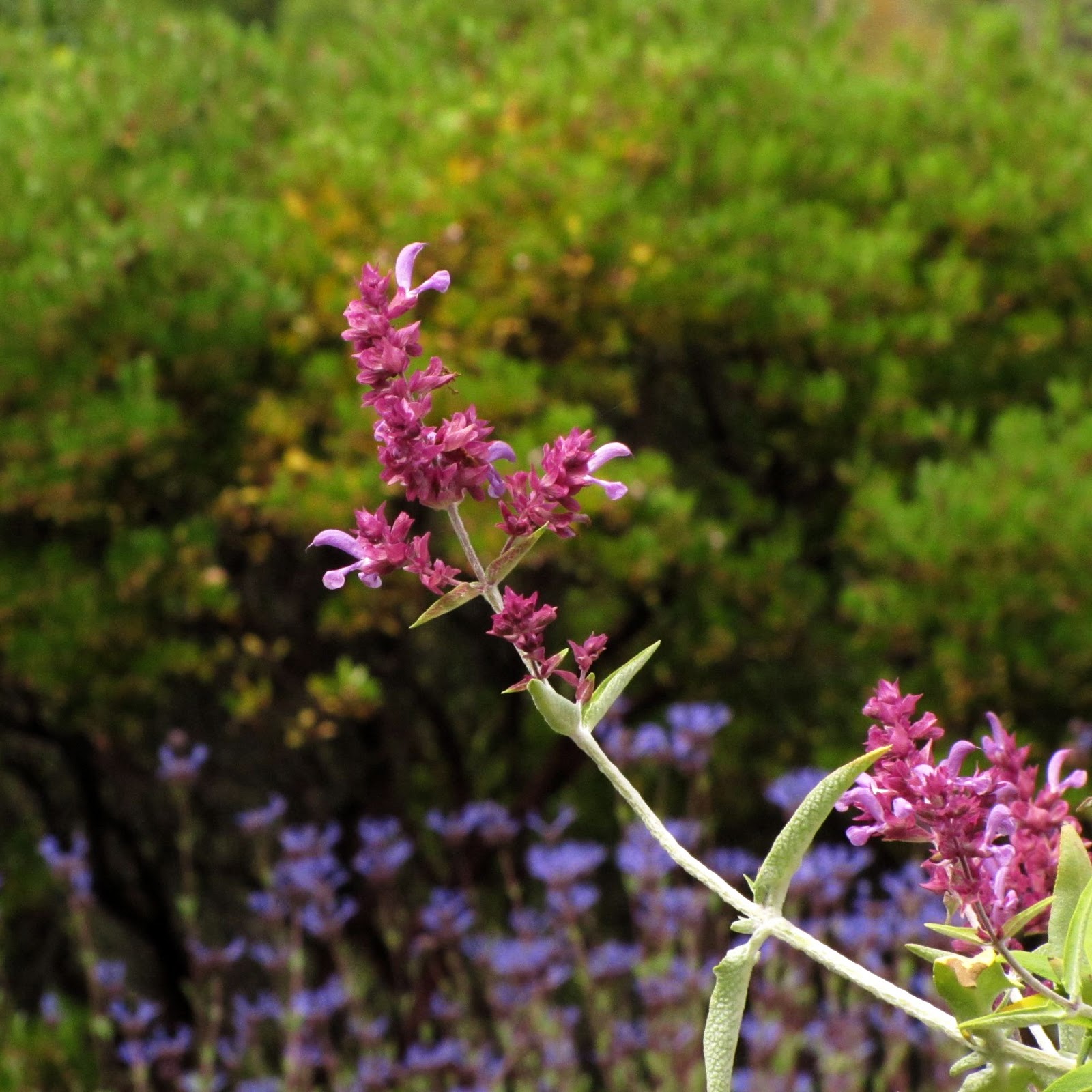
I enjoy the pungence of Salvia clevelandii in verrry small doses; it is a quintessential California scent. Was interested to see this variety, Salvia leucophylla x clevelandii 'Pozo Blue' which is more tolerant of summer water than the species, and has a softer scent.
The only plant I couldn't identify, it looks like a lovely yellow Salvia.
Probably a good contender for most intense flower of the day, this Butterfly Flower (Schizanthus grahamii), an annual for dappled shade, really has to be experienced in person to believe. Makes me think of cartoon clowns!
Certainly the winner for most bizarre plant in the place, Porcupine Tomato (Solanum pyracanthum) is a tender perennial with the craziest orange spines along the veins of its blue-green leaves. Click the photo to enlarge, see link for a picture in bloom.
Whew! Safely back to the soft yellow flowers of Verbascum 'Cotswald King.' At first I thought it was a Hollyhock! This species Verbascum is a biennial that comes true from seed, and is snail resistant (sold!)
Winding down for a cool, blue finish with Corsican Violet (Viola corsica) a shade perennial that reseeds nicely.
And a drumroll please for our final plant, with the unfortunate common name of 'Southern Lilac Drumsticks' (Zaluzianskya villosa) a perky annual from South Africa with flowers that look like they should be sprinkled on a cake.
Please enjoy your own visit to Annie's via these links; they'll be happy to ship plants to you with great care. And California gardeners, start planning your pilgrimage!
Thursday, June 24, 2010
Native Treasures on the Urban Fringe
I went to my favorite hiking place today, a visit long overdue (as my knees are reminding me tonight!) The Fremont Older Open Space Preserve in the Saratoga/Cupertino CA foothills overlooks the valley that has been home for most of my life. From the top of Hunter's Point I can see most of the places where my family has worked and lived, from Moffett Field where Dad was stationed in 1964 to the converted prune factory where I experienced the dot.com boom more than 30 years later. To come here isn't to get away from it all, but rather to see the bigger picture. Wild places like these, made safe and accessible to everyone, are resources to be treasured (and supported!)
Fremont Older was a well-known newspaper editor in San Francisco at the turn of the last century. In 1914 he built his home, Woodhills, on this land, catching the train at the bottom of the hill each morning to his office in the city. His wife, Cora Baggerly Older, was a writer, and oversaw the building of the extensive gardens around Woodhills.
The preserve includes Woodhills and its lands, and truly does exist at the urban fringe; one end borders a golf course, and luxury homes dot the skyline. Within its 739 acres you won't necessarily find nature untouched; the land was previously cultivated and is surrounded by roads, neighborhoods, vineyards, a reservoir, a quarry, stables, and mansions, which all have an impact. What you will find is a beautiful example of wild land restoration, and a great place to meet our lovely native plants growing among reminders of previous generations.
Here's a little tour of this unique corner of the world, where California natives and California history make for an interesting walk in the woods!
Everywhere this time of year is the unfortunately named Sticky Monkey Flower (Mimulus aurantiacus) which is my second favorite native flower (first will always be California Poppy)! Our cool, wet spring has it looking particularly lush for late June; lovely as it is now, Mimulus starts looking less than fresh when the dust of summer settles on its sticky leaves. In my garden it gets morning sun and the dry afternoon shade it seems to prefer (given a choice!)
I'm pretty sure this is Clarkia rubicunda, but not certain, since the flower wasn't open. So graceful (and once again I capture a previously unseen stowaway!)
Sigh. It would be nice if poison oak was this conspicuous color year-round (it is in fall, but this time of year it's mostly lush and oily and green, just waiting to cause misery). Seriously, I hope I didn't get too close just taking this picture!
Our native Blue Elderberry (Sambucus mexicana), was a big weed around my house near the coast many years ago; it loves the moist coastal woodlands, and is happiest here on a north slope with access to water. We treated it like buddleia; cutting to the ground in winter kept it 8'-12' tall each year. I never did anything with the berries or flowers (although I was curious about elderberry wine) and the birds appreciated that.
Yellow plums! Not sure if this tree is wild or a naturalized Prunus domestica; it is near the Ranger's house. Because of these and the fruits of California Bay (Umbellularia californica) you find lots of seed-filled scat along the trails. I was not quick enough to catch the deer, rabbits and family of foxes that I saw, but wildlife is everywhere here. Raccoons, opossums, skunks, and mountain lions (and an incredible assortment of birds, rodents and reptiles) also make this land home.
The first part of the trail is the road to Woodhills. Nearing the house, you'll see some of the original stonework done by the Quintero family, Italian stonemasons that Cora Older hired to build her gardens. Their touch is everywhere; this is but a small part.
Stone steps lead to what was once a large, formal garden where some of the most well-known writers, politicians, lawyers and artists of the time attended parties, sometimes with music provided by the San Francisco Symphony from a stone (of course!) grandstand.
I've always loved this adobe cottage located downhill from the main house; I think it would be a great studio! It must be where the caretaker lived, with stables nearby.
Signs of cultivation tell us a garden is nearby, like this Jerusalem Sage (Phlomis fruticosa) which, because of its Mediterranean heritage is right at home here.
This venerable Manzanita (Arctostaphylos) is one of my favorite plants; watching it grow even more magnificent over the last ten years has been a pleasure. I'm not sure of the variety, might be Dr. Hurd. Its large gray-green crown provides a backdrop to the house gardens above it. And those smooth, peeling trunks, well, you can see the appeal. Click the picture for a closer look.
OK, so when was the last time you came across a grotto built by Italian masons on a hike? I'm not sure if all of this work was done at the same time the house was built, but it definitely says Roaring Twenties more than Depression era to me. There are several such fancies around Woodhills, reminders of what must have been a magnificent woodland garden. As someone who enjoys designing hardscape, I wonder how many people will be looking at structures I designed in 100 years...
I'm pretty sure this is St. Catherine's Lace (Eriogonum giganteum) the largest of our native Buckwheats, getting ready to bloom. This is a great 'at the fringes' plant that needs no summer water and blends well with other 'fringers.' I need to come back soon and catch the bloom to be sure.
Come around the bend, and there is Woodhills. Surprisingly modern looking for a house built in 1914, it has been painstakingly restored by a retired Cupertino newspaperman and his family. It is open several times a year for docent tours; the guest book signed by famous San Franciscans like William Randolph Hearst is a must-see for local history buffs.
The gardens around Woodhills are full of choice natives and compatible imports. A beautiful bank of Salvia clevelandii, (commonly known as Blue, Musk, Chaparral or Cleveland Sage, depending on who you talk to) brightens a dry slope near the drive. It is one of the most aromatic of our native sages and a huge favorite of hummingbirds.
Yes, the current residents of Woodhills love Salvias! Their daughter works for a landscaping firm specializing in low-water native gardens, so you can be sure that they have been well supplied with choice selections, like Germander Sage (Salvia chamaedryoides). This Mexican native is a wonderful combination of true blue flowers and soft silver foliage that combines well with anything.
Canary Island Sage (Salvia canariensis candidissimum) is a robust plant, and its dusky rose color goes so well with the Cleveland Sage behind. And there's the top of my favorite Manzanita in the background! The combination of these three plants in any garden would make it a hummers paradise.
Not all is native, which is fine with me. I love an eclectic group that plays well together, with occasional scene-stealers, like this cute Tree Euphorbia (Euphorbia lambii) next to the pond.
Or this KILLER combination of Honey Bush (Melianthus major) and Autumn Sage (Salvia greggii) which do well in dry sun, and even some shade. Melianthus is from South Africa, another Mediterranean source of plants that love our climate and thrive here.
This, my friends, is why they call it a 'Smoke Bush!'
A beautiful specimen of Vine Maple (Acer circinatum) in a sheltered spot; the soft leaves are so graceful, and turn incredible colors in the fall. A great native alternative to a Japanese Maple.
Wonderful together: Western Sword Fern (Polystichum munitum) and Yerba Buena (Satureja douglasii) an aromatic creeping herb. Both are very happy dry shade dwellers.
Leaving Woodhills behind, step through a stile and out into the hayfields that mark the center of the preserve and the crossroads for all its trails. If California has a color palette, these golds and greens are on it.
Coyote Brush (Baccharis pilularis) is one of the first evergreen plants to return to an area that has been disturbed, so it's not surprising to find it growing lush next to the trails and the fire roads. This is the plant I recently found sprouted in my front garden that I'm going to let stay for awhile.
Ha, this was hilarious. Just as I was considering the 'urban fringe' angle of this post, I look up to see the Farmers Insurance blimp, flying over the valley, practically at eye level! I definitely wasn't lost in the wilderness...
A classic California Chaparral trio; Mimulus and Baccharis combined with silvery California Sagebrush (Artemisa californica).
A gorgeous California Buckeye (Aesculus californica) showing off its huge, fragrant flowers. This beautiful tree has the unfortunate habit of going alarmingly brown and dormant by midsummer. So we enjoy it while we can, and look forward to collecting the huge shiny seeds in winter.
Skeletal reminders that a portion of the preserve was at one time a walnut orchard. In fact, most of the valley below was orchard when the Olders built Woodhills. Before it was 'Silicon Valley' it was 'The Valley of Heart's Delight,' a huge producer of apricots, cherries and plums.
As I was shooting this last Mimulus, growing so happily with poison oak, I realized that I prefer to see these native treasures in their natural habitat (even growing with the poison oak!) rather than in a garden; unless, of course, the garden is an oak woodland. So while my cultivated gardens will always have some natives tucked into appropriate spots, I think I will head to the hills to see my wild ones, and support places that make that possible.
The Fremont Older Open Space Preserve is part of the Midpeninsula Regional Open Space District. It is dog, bike, and even stroller friendly in parts. They do a great job. Happy Trails!
Subscribe to:
Posts (Atom)