One of the things one has to give up as a garden designer is an attachment to the way a garden develops after the crew leaves. When the wrong gardener is chosen, whether it's a maintenance man with a hedge trimmer or a do-it-myself home gardener who doesn't do it themselves, the results can be disappointing. But with the right team in place a new landscape has a fighting chance to be fabulous!
I've written about this charming home in Los Altos before; I consider it one of my best efforts at transforming a traditional lawn-centric suburban garden into something really different and interesting. Here's a report from its third spring, as seen on an unseasonably rainy day in late May.
This is where we began; the house was getting a total remodel, and the garden would too. Thick Pittosporum hedges were crammed against traditional white picket fence. An uneven flagstone path bisected a scruffy lawn, and there were some random planting beds. Dreadful as it was, the owner liked the privacy and the cottage garden feel of it, and wanted to try to get that feeling in the new design, but in a fresh, colorful, picket-less way.
It's easier to see what we did in this picture taken during planting (December, 2008). The garden was divided into quadrants, with a mortared flagstone path from the street to the house, and large flagstone step stones from the driveway to the side gate. Three of the quadrants were planted with Arbutus 'Marina' trees that in combination, from different angles, provide most of the privacy the house needs.
Soft shrubs like Dodonea purpurea, Leptospermum 'Apple Blossom' and Rhamnus alaternus variegata form a soft curving buffer at the right of the garden. The largest arbutus was placed squarely in front of the porch window, to protect it from the strong western sun in the summer, and curious passers-by on the street! A strong edging of ledger stone separates the garden from the gravel parking strip (no sidewalks on this side of the street).
Design note; if I had "played it safe" with color and used lots of purples, blues and silvers to cool down the strong color of the house, the effect would have been rather drab, kind of like the picture above. Consider instead where we chose to go:
Gold, purple and coral? Oh yes, let's.
Cooling touches of blue? Of course! But we love this purple sage even more for its wonderful two-tone leaves. These have lasted longer than typical, and will probably need to be replaced next spring. No problem; they achieve mature size the first season!
Let's all just have a moment of silence at the sheer loveliness of this combination. From the top: Coleonema 'Sunset Gold' Loropetalum 'Plum Delight' Pittosporum 'Creme de Mint' Heuchera 'Marmalade' and Pinus 'Mugo.' The Loropetalum and Pine will slowly get taller over time; we're shaping them as we go. The Pittosporum and Heuchera will stay low, the Coleonema will stay broad and softly spreading. This is a zoomed shot, so there is actually room for all this to happen. I like the light touch of Blue Fescue at the top...
I'm a sucker for a palette that takes the same colors and shuffles them around in different textures and combinations. Here the Coleonema and Pittosporum are joined by Phormium 'Gold Wave.'
The backdrop for this shot of Pine and Heuchera is Lonicera 'Lemon Swirl' a delicious, arching delight with tiny variegated leaves along every stem. It captures the light and makes a perfect filler/spreader in this kind of planting, where the other players are more or less stationary. Avoid too many of this type in a landscape; they tend to dominate the conversation!
One plant that I knew I must put in this landscape is Coprosma 'Evening Glow' whose shiny, evergreen leaves were the same colors as the house, and go great with the Pittosporum and the coral carpet roses.
[Insert mini rant here] Too often I see this shrub looking dreadful...awkward and sprawling. This is not the plant's fault; it's just lack of early training. So designers, listen up and help your clients give their Coprosma the tough love they require, or be prepared to do it yourself!
On the care and training of Coprosma:
This is a plant that you need to be firm with during its youth. It wants to send up exuberant, luxurious plumes of gorgeous leaves in random directions; and these MUST be cut back hard to help you form the basis of a neater mature shrub. Once or twice a year should do it (and I'm talking about being a MAN and taking your clippers and cutting it back to a nice pair of shoots or buds at your desired shrub-level. I'm NOT talking about shearing; don't be lazy!) Use them in a flower arrangement, if that makes you feel better!
As the side shoots start growing, pinch their tips. The more pinching, the denser the shrub. The one above gets pruned/pinched a few times a year, so it's rather free form. If you think that sounds like too much maintenance, would you rather mow/edge/weed a lawn or give your fingernails a little workout?
Be brave. I know, it's hard. I'm much more daring with my client's plants than with my own, I KNOW the "it's still got one flower on it" syndrome. Get over it. Sometimes good horticultural practice is to prune; for balance and to stimulate growth where you want it. It's an art. Think of it that way; plants as the medium, shaped by your touch. Good plantsmanship is one of the best skills a designer can bring to the table.
In the photo album I linked to above, I explore the choices I had for pottery. I loved the way this particular combination turned out: rustic Mexican pots planted with an unusual gold-tipped variety of Crassula ovata flank the front window, and get by with occasional hand watering. Notice the classic Craftsman pattern I chose for the porch stonework. The same stone in natural form was used for the front walkway as well.
Bold color continues in the back, with this stunning Cercis 'Forest Pansy' as the main focal point between the two patios. One of my top ten favorite trees...
The back is shadier, and has some lovely combinations like Polystichum polyblepharum and Begonia richmondiensis. This fern looks best if you trim away all of the previous year's fronds before the new ones start to unfurl in spring; this keeps it looking fresh and tidy all summer.
Another interesting tone-on-tone color combination; Nandina filamentosa has the same tints as the Coprosma next to it, but with any airy, delicate texture. It is a slow grower, but I appreciate that in a plant; it's good when plants work well in the place they are given AND play nicely together.
Part of the reason this garden looks so good is because I personally visit it several times a year (at the owner's request) to clean up; shape, train and evaluate. We include his arborist and landscape contractor in our discussions to take care of the heavier tasks. It doesn't take long, and it's nice when the client joins me to clean up the daylilies and give everything else a once-over.
Even after three years there are still many plants in this garden that I've never had to touch. That, to me, is a landscape that's working, and my client agrees. As I left that day, he said "You done good."
Monday, June 20, 2011
Wednesday, June 1, 2011
Late Spring on the Los Gatos Creek Trail
A couple of months ago I posted about what it was like on the Los Gatos Creek Trail in early spring. Time for a followup! I took advantage of a dramatic clouds-and-blue-sky day to capture some mid-spring loveliness.
The Buckeyes (Aesculus californica) have quickly gone from tufts of leaves to large, fragrant racemes of flowers on long, leafy stems. So beautiful planted next to Redbud (Cercis occidentalis). In another two months they will start to fade into dormancy...so enjoy them now, darlings!
The Fennel (Foenicululm vulgare) is moving right along, and moves so gracefully with the surrounding grasses. I was surprised to see that the annual grasses had already gone to seed; I figured with the cool spring we're having that they might still be showing green. But this is a classic California palette, wouldn't you agree?
The glossy, red seedpods on the Redbuds are particularly striking now...
Not a weed here...
Oak buds...
An unexpected little meadow of statice...I wonder who planted it?
The Sycamore leaves are well on their way to enormity...beautiful texture.
Oak ball!
Yellow daisies...Helianthums?
Another dainty little thing...maybe an Eriogonum?
Back into familiar territory...did you ever wonder how Western Cottonwood (Populus fremontii) got its name? Wonder no more...this is one hot mess this time of year!
I mean, wow...
Not included last time was this gorgeous native, Sugar Bush (Rhus ovata) that my Facebook friends helped me identify. According to Cheryl Renshaw "The fruit is covered with a tart goop that you can suck on and then drink some water to sort of kind of have lemonade (hence the common name of the closely related Rhus integrifolia or Lemonade Berry). Cool!
Another view of Cottonwood...
Hawthorn flowers are so dainty compared to the dramatic and rather severe aspect of their bright red berries in winter. Love that leaf shape...
Eucalyptus flowers; this whole tree is aromatic.
Remember Squirrel Nutkin? (Totally dating myself, aren't I!)
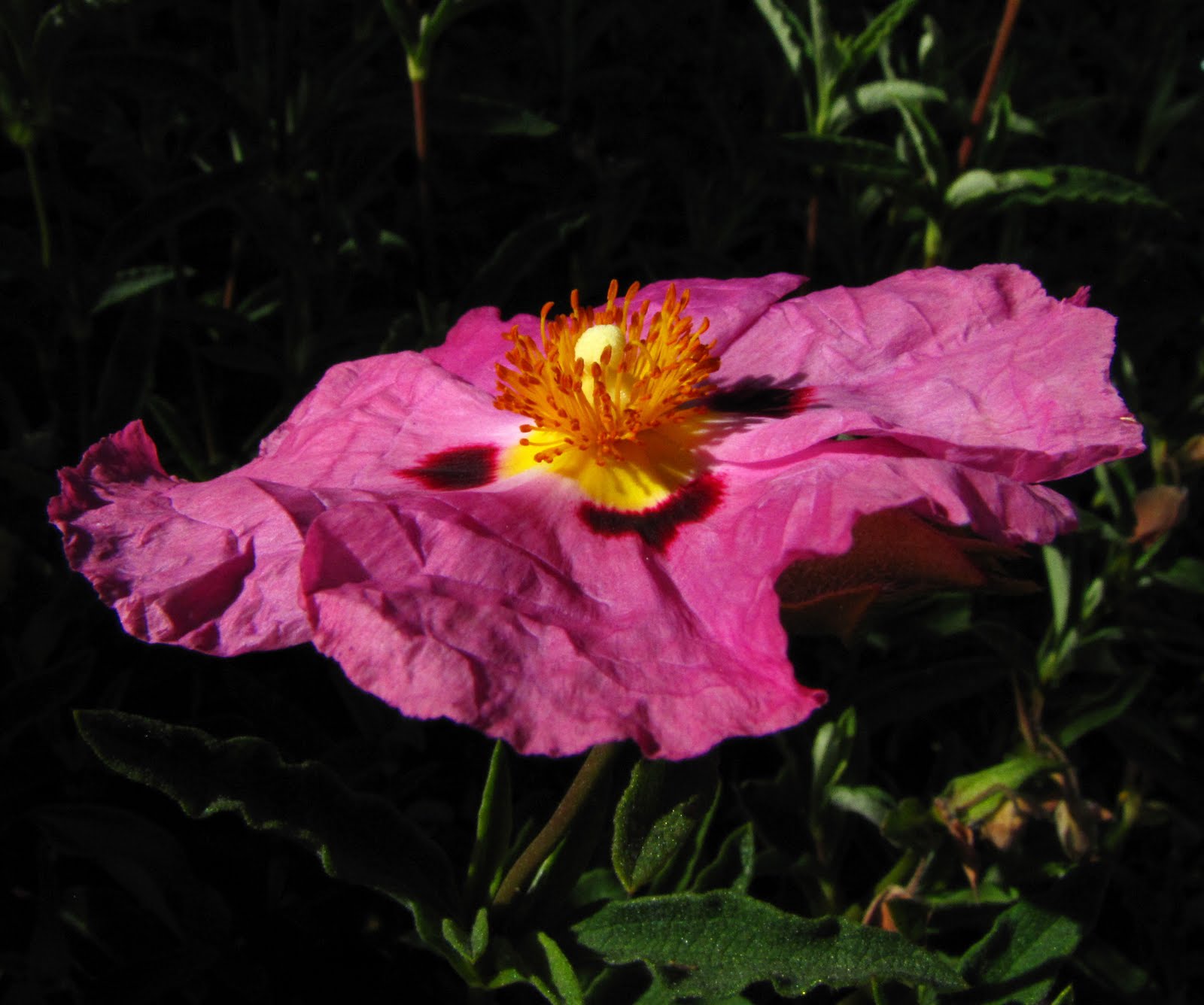
One, last luminous Cistus blossom along the path leading home...thanks for joining me! Things will look quite different soon...
The Buckeyes (Aesculus californica) have quickly gone from tufts of leaves to large, fragrant racemes of flowers on long, leafy stems. So beautiful planted next to Redbud (Cercis occidentalis). In another two months they will start to fade into dormancy...so enjoy them now, darlings!
The Fennel (Foenicululm vulgare) is moving right along, and moves so gracefully with the surrounding grasses. I was surprised to see that the annual grasses had already gone to seed; I figured with the cool spring we're having that they might still be showing green. But this is a classic California palette, wouldn't you agree?
The glossy, red seedpods on the Redbuds are particularly striking now...
Not a weed here...
Oak buds...
An unexpected little meadow of statice...I wonder who planted it?
The Sycamore leaves are well on their way to enormity...beautiful texture.
Oak ball!
Yellow daisies...Helianthums?
Another dainty little thing...maybe an Eriogonum?
Back into familiar territory...did you ever wonder how Western Cottonwood (Populus fremontii) got its name? Wonder no more...this is one hot mess this time of year!
I mean, wow...
Not included last time was this gorgeous native, Sugar Bush (Rhus ovata) that my Facebook friends helped me identify. According to Cheryl Renshaw "The fruit is covered with a tart goop that you can suck on and then drink some water to sort of kind of have lemonade (hence the common name of the closely related Rhus integrifolia or Lemonade Berry). Cool!
Another view of Cottonwood...
Hawthorn flowers are so dainty compared to the dramatic and rather severe aspect of their bright red berries in winter. Love that leaf shape...
Eucalyptus flowers; this whole tree is aromatic.
Remember Squirrel Nutkin? (Totally dating myself, aren't I!)
One, last luminous Cistus blossom along the path leading home...thanks for joining me! Things will look quite different soon...
Tuesday, April 26, 2011
Garden Designers Roundtable: Top Landscape Plants
Welcome to this month's Garden Designers Roundtable, where we are talking about the plants that we turn to again and again in our designs. My working palette is pretty vast, but these are the ones special enough to be used in my personal gardens as well.
Easily the most-used small tree in my repertoire is Arbutus 'Marina' a hybrid of our native Madrones. This was the first thing I planted in my last garden, and in four years that small shrub became this shapely specimen, with peeling red trunks, clean evergreen foliage and a long season of bloom. I also use it extensively in the standard form, and would love to see it used more as a street tree.
One of my favorite groundcovers under Arbutus is Elijah Blue Fescue (Festuca glauca). It appreciates a little shade and water to look its best; and makes a wonderful 18" mound of blue that is tough, soft, and looks great year round.
A good companion to blue fescue in a grassy landscape is the lovely Carex testacea. Its blades shift from olive green to coppery orange and back again throughout the year. This one will reseed freely if you don't keep its long flowing seed stems trimmed; you've been warned!
Soft, friendly Coleonema 'Sunset Gold' looks great planted near orange sedge; its golden plumes (and in the spring, small pink flowers) are a bright spot in any garden; it needs sun for best color.
A relatively new addition to my palette is Dianella; I use several varieties, like this Dianella caerulea (Blue Flax Lily). It's wonderful in a pot and happy in those spots that aren't quite sun and not full shade. The little blue flowers on airy stems are charming.
Somewhere in the background of my gardens you might find Dodonea purpurea (Purple Hopseed Bush). I adore the deep burgundy of the leaves in winter, and the graceful shape of the leaves and stems. They tend to be a little shallow-rooted and can tip over in wet/windy weather; firmly staking them until they are past their youth will keep them safe. In time makes an interesting small tree.
Except, just maybe, Nandina 'Firepower' a short, large-leafed variety that is simply gorgeous all year round. Happiest in part shade, with just enough sun to bring out the peach, red and copper tones in the leaves. Doesn't need much water, stays compact, with no pests to speak of.
Another contender for little Mr. Perfect is this variety of Pittosporum tenuifolium called "Golf Ball." Naturally neat and compact, looks shiny perfect all year round with little or no pruning. Those black stems and soft green leaves are killer, and if I were to make a small hedge, THIS is what I would use...
...not this. I am not a fan of boxwood usually, but this is my bright, shining exception. I like to dot variegated English Boxwood around a landscape (often zig-zagging along a path at wide intervals). Their leaves have a particularly luminous quality that just lights up the place, especially in shade. It is slow growing, tough, and needs only an occasional pinch (never sheared, thank you) to look great.
And of course, Succulents are like sprinkles for the landscape...bright, colorful, sculptural, undemanding and now available in SO many varieties that the possibilities are endless. They are often that perfect missing color or texture, especially in dry corners.
So now you know my short list...but don't stop here! My fellow Garden Roundtablers are spilling their secrets too, including guest blogger Nan Ondra; such an honor to have her here today. Enjoy!
Nan Ondra : Hayefield : Bucks County, PA
Andrew Keys : Garden Smackdown : Boston, MA
Christina Salwitz : Personal Garden Coach : Renton, WA
Genevieve Schmidt : North Coast Gardening : Arcata, CA
Ivette Soler : The Germinatrix : Los Angeles, CA
Jocelyn Chilvers : The Art Garden : Denver, CO
Lesley Hegarty & Robert Webber : Hegarty Webber Partnership : Bristol, UK
Rebecca Sweet : Gossip In the Garden : Los Altos, CA
Rochelle Greayer : Studio G : Boston, MA
Susan Morrison : Blue Planet Garden Blog : East Bay, CA
Easily the most-used small tree in my repertoire is Arbutus 'Marina' a hybrid of our native Madrones. This was the first thing I planted in my last garden, and in four years that small shrub became this shapely specimen, with peeling red trunks, clean evergreen foliage and a long season of bloom. I also use it extensively in the standard form, and would love to see it used more as a street tree.
One of my favorite groundcovers under Arbutus is Elijah Blue Fescue (Festuca glauca). It appreciates a little shade and water to look its best; and makes a wonderful 18" mound of blue that is tough, soft, and looks great year round.
A good companion to blue fescue in a grassy landscape is the lovely Carex testacea. Its blades shift from olive green to coppery orange and back again throughout the year. This one will reseed freely if you don't keep its long flowing seed stems trimmed; you've been warned!
Soft, friendly Coleonema 'Sunset Gold' looks great planted near orange sedge; its golden plumes (and in the spring, small pink flowers) are a bright spot in any garden; it needs sun for best color.
A relatively new addition to my palette is Dianella; I use several varieties, like this Dianella caerulea (Blue Flax Lily). It's wonderful in a pot and happy in those spots that aren't quite sun and not full shade. The little blue flowers on airy stems are charming.
Somewhere in the background of my gardens you might find Dodonea purpurea (Purple Hopseed Bush). I adore the deep burgundy of the leaves in winter, and the graceful shape of the leaves and stems. They tend to be a little shallow-rooted and can tip over in wet/windy weather; firmly staking them until they are past their youth will keep them safe. In time makes an interesting small tree.
I really appreciate plants that look great in winter and early spring, when the rest of the garden is resting. Euphorbias, like this "Helena's Blush" fill the bill nicely. I would use them even more if they didn't smell, well, stinky. Ah well, nobody's perfect!
Except, just maybe, Nandina 'Firepower' a short, large-leafed variety that is simply gorgeous all year round. Happiest in part shade, with just enough sun to bring out the peach, red and copper tones in the leaves. Doesn't need much water, stays compact, with no pests to speak of.
Another contender for little Mr. Perfect is this variety of Pittosporum tenuifolium called "Golf Ball." Naturally neat and compact, looks shiny perfect all year round with little or no pruning. Those black stems and soft green leaves are killer, and if I were to make a small hedge, THIS is what I would use...
...not this. I am not a fan of boxwood usually, but this is my bright, shining exception. I like to dot variegated English Boxwood around a landscape (often zig-zagging along a path at wide intervals). Their leaves have a particularly luminous quality that just lights up the place, especially in shade. It is slow growing, tough, and needs only an occasional pinch (never sheared, thank you) to look great.
And of course, Succulents are like sprinkles for the landscape...bright, colorful, sculptural, undemanding and now available in SO many varieties that the possibilities are endless. They are often that perfect missing color or texture, especially in dry corners.
So now you know my short list...but don't stop here! My fellow Garden Roundtablers are spilling their secrets too, including guest blogger Nan Ondra; such an honor to have her here today. Enjoy!
Nan Ondra : Hayefield : Bucks County, PA
Andrew Keys : Garden Smackdown : Boston, MA
Christina Salwitz : Personal Garden Coach : Renton, WA
Genevieve Schmidt : North Coast Gardening : Arcata, CA
Ivette Soler : The Germinatrix : Los Angeles, CA
Jocelyn Chilvers : The Art Garden : Denver, CO
Lesley Hegarty & Robert Webber : Hegarty Webber Partnership : Bristol, UK
Rebecca Sweet : Gossip In the Garden : Los Altos, CA
Rochelle Greayer : Studio G : Boston, MA
Susan Morrison : Blue Planet Garden Blog : East Bay, CA
Thursday, April 14, 2011
An EnSeven Kind of Spring...
YES, it's spring! The leaves on "my" Liquidambar tree are unfurling at a rapid pace. I recently played tree-hugger to make sure the company doing tree maintenance at my complex didn't remove these graceful branches that are the only thing between me and a blank stucco wall. The foreman was sympathetic, so no particular heroics were required...
Another sign of the season: Western Mourning Doves on the lookout for precarious and/or ridiculous places to make their nests. I love these birds; their plaintive call is part of the soundtrack of my life. But they haven't quite grasped the whole "location location location" idea yet...
Moving on down the food chain, I was delighted to see the Praying Mantis egg case that I brought from my house spring to life a couple of weeks ago. The infants kind of pour out the front enclosed in a protective shell, which they quickly wriggle out of. As the first-born get their bearings they can be seen hanging around waiting to make a snack out of their younger siblings! I dispersed a few around the balcony and will be interested to see if any of them hang around; they are very territorial and if happy will spend a whole lifetime in a single bush. Stay tuned...
This was the first spring in almost 25 years that I haven't had a garden to wake up and get ready for the season. It seems very strange. No piles of weeds to the compost pile, no prunings piled in the street, no mulch to buy, no heirloom tomatoes to covet. My big tasks were switching to a lighter throw for the love-seat and vacuuming the sisal rug. I didn't even need to get dressed for that, let alone put on sunscreen, gloves and hat. Strange, I tell you.
But still, there are delights. I love how this cutting of Corylus avellana 'Rote Zeller' (European Red-Leaf Filbert) from my friend Alice Joyce's garden is coming along; those pleated purple leaves! In the garden it would be a massive shrub; I will enjoy it on a smaller scale.
Talk about a great container plant for a shady garden; this Dianella caerulea (Blue Flax Lily) is evergreen, low-maintenance, and is just getting ready to bust out in luxurious bloom. It is a good choice for my balcony because it can take full shade to full sun; depending on the time of year (or the time of day) it can be either.
And of course, there are the succulents, like my favorite Aeonium 'Sunburst.' These are another kind of plant that does surprisingly well in part sun or shade; they will be looser and lankier with less sun, but no less pretty. I find their leaves stay fresher and they grow slower...both good attributes for a small-space garden. And in a low-light situation they need even less water.
This plump fellow has been growing in shade for several years with just an occasional sip of water. My kind of plant!
Dwarf jade plant (Crassula argentea 'Hobbit') is another sun to shade winner: growing about an inch a year it may reach an eventual height of 2 feet, maybe! As the sun gets higher my balcony will get shadier...it will be interesting to see what thrives this season. I don't really miss all the work of a big garden, really I don't. And it's nice to be able to concentrate on the small details of a more intimate space. Thanks for joining me...
Another sign of the season: Western Mourning Doves on the lookout for precarious and/or ridiculous places to make their nests. I love these birds; their plaintive call is part of the soundtrack of my life. But they haven't quite grasped the whole "location location location" idea yet...
Moving on down the food chain, I was delighted to see the Praying Mantis egg case that I brought from my house spring to life a couple of weeks ago. The infants kind of pour out the front enclosed in a protective shell, which they quickly wriggle out of. As the first-born get their bearings they can be seen hanging around waiting to make a snack out of their younger siblings! I dispersed a few around the balcony and will be interested to see if any of them hang around; they are very territorial and if happy will spend a whole lifetime in a single bush. Stay tuned...
This was the first spring in almost 25 years that I haven't had a garden to wake up and get ready for the season. It seems very strange. No piles of weeds to the compost pile, no prunings piled in the street, no mulch to buy, no heirloom tomatoes to covet. My big tasks were switching to a lighter throw for the love-seat and vacuuming the sisal rug. I didn't even need to get dressed for that, let alone put on sunscreen, gloves and hat. Strange, I tell you.
But still, there are delights. I love how this cutting of Corylus avellana 'Rote Zeller' (European Red-Leaf Filbert) from my friend Alice Joyce's garden is coming along; those pleated purple leaves! In the garden it would be a massive shrub; I will enjoy it on a smaller scale.
Talk about a great container plant for a shady garden; this Dianella caerulea (Blue Flax Lily) is evergreen, low-maintenance, and is just getting ready to bust out in luxurious bloom. It is a good choice for my balcony because it can take full shade to full sun; depending on the time of year (or the time of day) it can be either.
And of course, there are the succulents, like my favorite Aeonium 'Sunburst.' These are another kind of plant that does surprisingly well in part sun or shade; they will be looser and lankier with less sun, but no less pretty. I find their leaves stay fresher and they grow slower...both good attributes for a small-space garden. And in a low-light situation they need even less water.
This plump fellow has been growing in shade for several years with just an occasional sip of water. My kind of plant!
Dwarf jade plant (Crassula argentea 'Hobbit') is another sun to shade winner: growing about an inch a year it may reach an eventual height of 2 feet, maybe! As the sun gets higher my balcony will get shadier...it will be interesting to see what thrives this season. I don't really miss all the work of a big garden, really I don't. And it's nice to be able to concentrate on the small details of a more intimate space. Thanks for joining me...
Subscribe to:
Posts (Atom)