I'm taking a slightly different approach to the Garden Designers Roundtable "Regional Diversity" topic by exploring the different ways that designers present their ideas to clients. I asked some of my GDBL co-Horts to send samples of their work, and what I received was even more remarkably diverse than I had hoped.
~Click on any image to enlarge ~
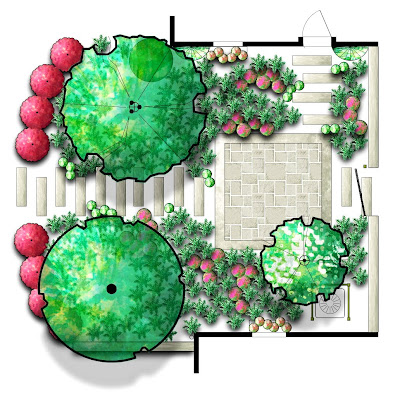
New Jersey designer Susan Cohan uses
Dynascape design software, probably the most popular landscape-specific CAD program for PC users. This is an example of a preliminary design plan that she might email to a client at the beginning of a project to whet their appetite. Susan LOVES a salivating client.
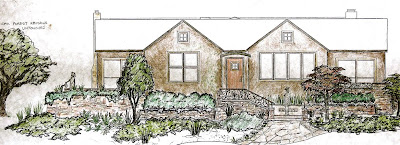
California designer Michelle Derviss, an artist since she discovered that crayons were meant for coloring with rather than eating, draws her beautiful plans by hand. This preliminary sketch shows softscape massing and the layering of the exterior stone work and wrought iron railings.
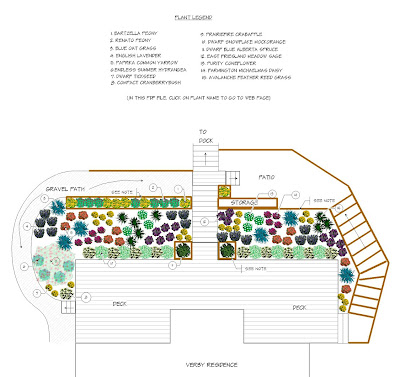
Idaho designer Dan Eskelson adds a new high-tech twist to his CAD drawings. Here he has created a PDF planting plan, with plant names live-linked to their descriptions/care at the
Monrovia website. His client loved the interaction. This is a great example of what I refer to as 'live' drawings; when using CAD a drawing is always active and changeable, no matter the level of detail or finish (as opposed to a static hand-rendering which, once complete, cannot easily be changed.)
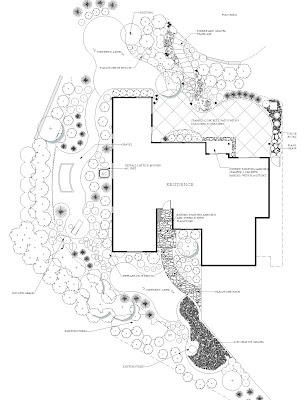
California designer Susan Morrison uses
Vectorworks design software to create her plans. She typically does a multi-page set for her clients, including a landscape plan (shown) hardscape plan and planting plan. While it was a big learning curve to transition from hand-rendering to CAD, Susan appreciates how much cleaner and easier it is for her to draw on the computer. Plus she loves being able to email clients PDF snapshots of work in progress.
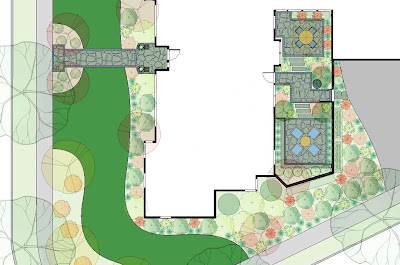
This is one of my drawings. I also use Vectorworks (which is pretty much the only game in town for Mac users) but I use it a little differently than Susan. I am a 'pretty picture' designer, and use very few of the tools available in the program, preferring to capture everything in one drawing that develops over time.
This is a preliminary concept plan that shows proposed hardscape in some detail, and the shape and general layout of planting beds. Subsequent revisions will refine the design, but my bias is to get off the paper and into the dirt as quickly as possible, making final decisions onsite with the client and contractor. I call out large trees and shrubs on my plans, but rarely do a detailed planting plan for smaller material, preferring instead to work off a plant palette and create once the plants are delivered. I've been using CAD for four years and adore it; my drawing table is in the garage.
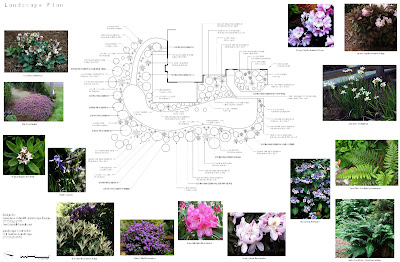
California designer Genevieve Schmidt uses Dynascape to create beautifully refined planting plans that include plant photographs. While she uses her own photos of the plants she uses most often, Dynascape also has plant photos, many from
Horticopia. Most of Genevieve's work is planting plans, and her clients appreciate being able to get a feel for the plants used (through the photos) without having to learn botanical names and examine the plans at length.
Another thing Genevieve loves about Dynascape is that she can export a plant list from the plan and create a quote, so she can give her clients and contractors an idea of how much the plants will cost.
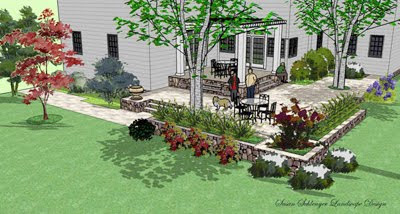
Virginia designer Susan Schlenger likes to wow her clients with 3D renderings! With new programs (like Susan's tool of choice, Google's awesome
'SketchUp') such renderings are now within easy reach of designers, and are amazingly effective as presentation tools. While two-dimensional plans may speak to us, few clients can really visualize a garden from them. No such problem here.
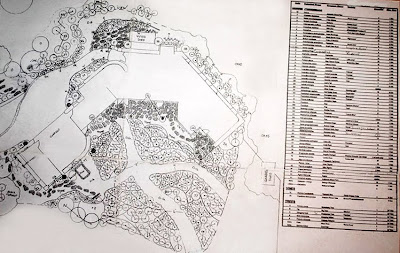
Last but certainly not least, California designer Rebecca Sweet likes to do things the old-fashioned way, and is remarkably successful at it! Her hand-drawn plans and detailed plant legends get the job done just as well as anything else. Which should serve as a reminder that the sexiest CAD rendering is worthless without a skilled designer behind it. And it's not only the drawings, however they are made, that are important. It's how we communicate to our clients ABOUT the drawings.
There was quite a lively discussion about this as we prepared for these posts, and I think California designer Ivette Soler summed it up best, so I will close with her delightful and inspiring words:
My way of presenting my work embraces diversity to the core - I do it differently every time, depending on the client. Lately it involves me standing in the middle of their property waving my arms around, 'miming' the garden I have in my mind's eye. I find that for me, selling a garden is tapping into a client's dreams and fantasies, and if I can weave those into a story (with supporting plant images and drawings) the client is usually along for the ride! But for me, the story, the talking, the guiding the client through the wonder to come - THAT'S my biggest tool.
I think as garden designers, we are all storytellers! Capturing the essence of a garden is hard - plans can be too dry, plant photos never REALLY capture the full glory, and although a bouquet of cuttings has always been one of my 'secret weapons' (it's like bringing flowers on a date!) nothing seems to really 'get' the spirit of what a garden can do. That's where our passion fills in the gap, don't you think? I feel it when reading all of your blogs and tweets - the same energy that draws us together as a community gives us the spark to sell "The Dream!"
Enormous thanks to my fellow GDBL bloggers for making this post MUCH more interesting than it started out to be!
The GDBL Bloggers
Susan Cohan (Chatham NJ)
Miss Rumphius’ Rules
Rebecca Sweet (Los Altos, CA)
Gossip in the Garden
Dan Eskelson (Priest River ID)
Clearwater Landscapes Garden Journal
Pam Penick (Austin TX)
Digging
Michelle Derviss (Novato CA)
Garden Porn
Ivette Soler/(Los Angeles CA)
The Germinatrix
Susan Schlenger (Charlottesville VA)
Landscape Design Advice
Scott Hokunson (Granby CT)
Blue Heron Landscapes
Tara Dillard (Stone Mountain, GA)
Landscape Design Decorating Styling
Jocelyn Chilvers (Wheat Ridge, CO)
The Art Garden
Genevieve Schmidt (Arcata, CA)
North Coast Gardening
Susan Morrison (Concord, CA)
Blue Planet Garden Blog
Follow us on Twitter!
 Spring comes early in Northern California, so the the last weekend in January is a good time to prune roses and cut back ornamental grasses. After two weeks of rain, the return of the sun meant the garden was calling. Loudly. It's satisfying to reduce things to their lowest common denominator once in awhile.
 As opposed to, say, letting them stay all wild and woolly! I am a stickler for cutting grasses back hard; fresh new growth emerging from a haystack is NOT a good look. A couple months of lumpishness will be worth it when this Miscanthus wakes up.
 I can't believe how big the crown of this Pennisetum spatheolatum got in one year! This tight mound of old stems will give good support to the grass during the season.
 Look who was living all cozy in the grass crown; very happy to come out and twirl in the sun!
 Soft seedlings of Mexican Hair Grass are appearing here and there, just the way I like it!
 Is there anything more promising than the first daffodil buds?
 The Spanish Lavender is starting to emerge; a nice contrast to the dastardly oxalis!
 Oxalis, Lavender and Daffodil foliage, a classic California winter vignette
 This might be more classic in South Africa; Grevillea 'Coastal Gem' and Leucadendron 'Wilson's Wonder' combined with purple sage and blue fescue take over the show during cool weather.
 The last seed pods on the Cercis 'Forest Pansy.' Dreaming of purple, heart-shaped leaves in just a couple of months...
 Cerinthe major (yeah, again...she's one of those types who start mugging when they see a camera, how can I resist?)
 And they are everywhere!
 Pretty Tulbaghia simmleri is another lovely winter bloomer. And it's fragrant too!
 Ahhhh, saved the best for last; Hardenbergia violacea 'Happy Wanderer' is covering my back fence with loveliness; this is a nice vine to combine with climbing roses on an arbor, as it is so happy to take the winter shift. Thanks for joining me in the garden today!


